Why Scratch Cards Feel More Dangerous Than Jackpots
Most people don’t plan to play scratch cards.
That’s the first problem.
They don’t wake up thinking, “Today I’ll gamble.” They’re buying coffee. Gas. Milk. The scratch card appears at the counter, right where impulse lives. A colorful rectangle promising a quick moment of excitement. Five dollars. Maybe ten. Something small enough to ignore.
Jackpot tickets don’t work like that. They require intention. You know the draw date. You know you’re participating in something improbable. Scratch cards slide into daily life quietly, almost politely. And that subtle entry point changes everything.
“I Almost Won” and Other Dangerous Thoughts
Talk to regular scratch card buyers and you’ll hear the same phrases again and again.
“I don’t really gamble.”
“It’s just for fun.”
“I was so close last time.”
That last one matters more than people realize.
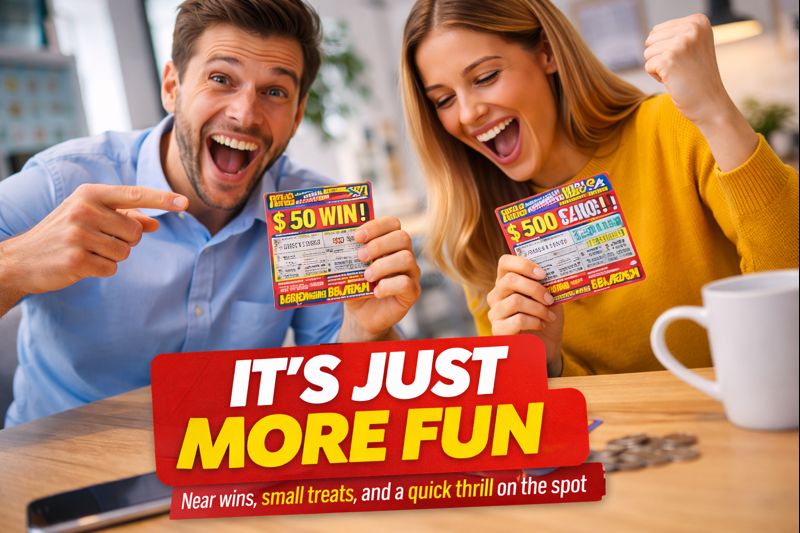
Scratch cards are built around near misses. Two matching symbols. One number away. A small win that conveniently covers the cost of the next card. The brain doesn’t register this as failure. It registers it as progress.
Jackpot games rarely create that feeling. You check your numbers, realize you lost, and move on. There’s no slow reveal. No moment-by-moment tension. No sense that the outcome was just out of reach. Scratch card losses feel personal. Jackpot losses feel abstract.
Why Near-Misses Keep People Playing
Psychology has a term for this pattern: variable reinforcement. It’s the same mechanism used in slot machines, mobile games, and endless social media feeds. Rewards appear unpredictably, which keeps the brain engaged far longer than consistent outcomes ever would.
Near-misses activate the brain’s reward system almost as strongly as actual wins. That’s not intuitive, but it’s well-documented. Losing in the “right way” doesn’t discourage behavior. It encourages it.
Scratch cards lean heavily into this effect. Jackpot lotteries don’t.
The Illusion of Control
Scratch cards also create something jackpots never really offer: the illusion of control.
People choose specific cards. They avoid the last one in the stack. They scratch slowly or save certain sections for last. None of this changes the outcome, which was determined the moment the card was printed. But it feels like it might.
That feeling is powerful.
Jackpot games are mechanical by comparison. You pick numbers or accept a quick pick. The process feels distant. Scratch cards feel interactive, and interaction deepens emotional investment.
Small Amounts, Repeated Often
Very few people would knowingly place a fifty-dollar bet on a long shot. But many people will spend five dollars ten times without noticing.
Scratch cards fragment spending. The cost feels harmless because it’s spread out. Five here. Ten there. Over weeks and months, the total quietly grows. By the time someone becomes aware of how much they’ve spent, it no longer feels like one decision. It feels like routine.
And routines are hard to question.
What the Numbers Quietly Show (U.S. vs Europe)
This is where the story stops being anecdotal.
In the United States, scratch cards consistently generate more revenue than Powerball and Mega Millions combined. In many states, instant games account for 60 to 65 percent of total lottery sales. That means the bulk of lottery money doesn’t come from billion-dollar dreams. It comes from small, frequent purchases that barely feel like gambling.
European markets show a similar pattern, though often less extreme. In countries like the UK, France, and Italy, instant-win games and scratch cards are among the top revenue drivers, even when large national draws dominate headlines. The difference is cultural framing. European players tend to treat scratch cards more openly as gambling, while in the U.S. they’re often marketed as casual entertainment.
Spending behavior also differs. U.S. scratch card players are more likely to buy repeatedly, sometimes daily. European players tend to buy fewer cards per visit but return regularly. In both cases, the long-term effect is the same: consistent, low-friction spending that adds up quietly.
There’s also a demographic pattern that rarely gets discussed. Scratch card sales are highest in lower-income areas on both sides of the Atlantic. Small purchases feel manageable. Justifiable. Earned. Over time, that framing matters more than odds ever could.
Why Scratch Cards Blend Into Everyday Life
Scratch cards fit into routines in a way jackpot games rarely do.
People scratch during lunch breaks. In their cars. At the kitchen table before dinner. Coworkers scratch together. Friends give cards as gifts. The act feels social, casual, and even comforting.
Jackpot games remain events. Scratch cards become habits.
That distinction matters.
Prize Size Isn’t the Real Risk
None of this means scratch cards are inherently harmful or that everyone who plays them is at risk. For many people, they genuinely are harmless entertainment.
The problem is how often that framing is used to dismiss their psychological impact entirely.
The danger isn’t that scratch cards promise too much. It’s that they ask for so little, so often, and so quietly. Risk in gambling is shaped less by how big a prize can be and more by how frequently a game invites you to play.
Scratch cards are often described as the “safe” lottery option because the prizes are assumed to be smaller. In reality, scratch-offs have produced some enormous payouts over the years, including multi-million-dollar wins that rival traditional jackpot games.
What Actually Makes a Lottery Game Risky
From a behavioral standpoint, risk has little to do with maximum payout.
Frequency matters more than prize size.
Speed matters more than odds.
Feedback matters more than logic.
Scratch cards hit all three pressure points at once. They resolve instantly. They encourage repetition. They create emotional hooks through near-misses and small wins.
Jackpot games do not.
The Risk We Don’t Like to Talk About
Scratch cards are often described as the “safe” lottery option because the prizes are smaller. But safety in gambling has never been about how much you can win.
It’s about how a game fits into your life. Your routines. Your spending patterns. Your emotional habits.
If lotteries want to talk honestly about risk, scratch cards deserve far more scrutiny than billion-dollar jackpots ever will. They don’t explode lives overnight.
They erode habits slowly.
And that kind of danger is much harder to see.

You May Like: