Mega Millions Makeover — What the 2025 Changes Mean for You
In 2025, Mega Millions raised its ticket price from $2 to $5, improved the odds of winning a prize from 1 in 24 to 1 in 23, and eliminated break-even prizes. While Powerball remains at $2 per ticket with slightly better jackpot odds and more forgiving low-tier prizes, Mega Millions now offers larger second-tier payouts and a flashier structure. The best option depends on whether you value affordability or the chance for higher non-jackpot winnings.
Something big happened to one of America’s favorite lottery games — and if you’re still playing Mega Millions the old way, it might be time to recalibrate your lucky numbers.
In April 2025, the Mega Millions lottery quietly rolled out some of the most significant updates it’s seen in over a decade. While some changes were met with applause, others had longtime players raising their eyebrows — and their ticket stubs. If you’ve bought a ticket recently and thought, “Wait, didn’t this used to be cheaper?”—you’re” not imagining it.
Here’s everything you need to know about how Mega Millions has changed, what those changes really mean for your odds, your wallet, and your winnings, and how to approach the game with fresh eyes in 2025.
The Price of a Dream Just Went Up
First things first: the base ticket price has officially jumped from $2 to $5. That’s more than double the old cost if you’re someone who religiously added the $1 Megaplier. The increase came with the promise of better odds and richer non-jackpot prizes, but for casual players, it’s a jolt.
Lottery officials say the move is about modernizing the game and enhancing prize tiers across the board — but for players, it’s now a more expensive leap of faith. For the cost of one Mega Millions ticket today, you could have bought two tickets and a donut back in 2019. And maybe even a coffee if you were lucky.

Buy One Mega Millions Ticket—Get One Free
Odds Are Shifting — But Are They Better?
While the jackpot odds didn’t change dramatically (you’re still facing astronomical odds: 1 in 302,575,350), the overall odds of winning any prize have improved slightly, moving from 1 in 24 to 1 in 23. That sounds small, but it can make a big psychological difference. More small wins might help keep players feeling engaged and hopeful — even if they’re not walking away with millions.
Interestingly, the game also dropped the “break-even” prize of $2. In other words, under the new format, every prize you win will now be worth more than the cost of your ticket. Whether it’s $10, $20, or hundreds, your win is guaranteed to have a positive return — at least in theory.
So while you might be spending more to play, you’re no longer winning just enough to play again. You’re winning more than you paid — assuming you win anything at all.
That Jackpot Is Bigger Than It Looks… Or is it?
As always, Mega Millions players must choose between two types of payouts: the long-term annuity or the upfront lump sum.
The annuity option stretches your jackpot over 30 years, with payments increasing annually. It sounds appealing—more money over time, and you avoid the “sudden wealth shock.” But most winners still choose the lump sum. It’s immediate, it’s tangible, and it comes with fewer what-ifs.
But here’s the kicker: the lump sum is significantly less than the advertised jackpot. When someone wins a $200 million prize and takes the lump sum, they might walk away with something closer to $100 million. Then the IRS drops by for its share.
In the new format, that decision remains just as critical. With higher ticket prices and potentially larger jackpots, the stakes of that choice feel even greater.
Mega Millions vs. Powerball — Which Game Treats You Better?
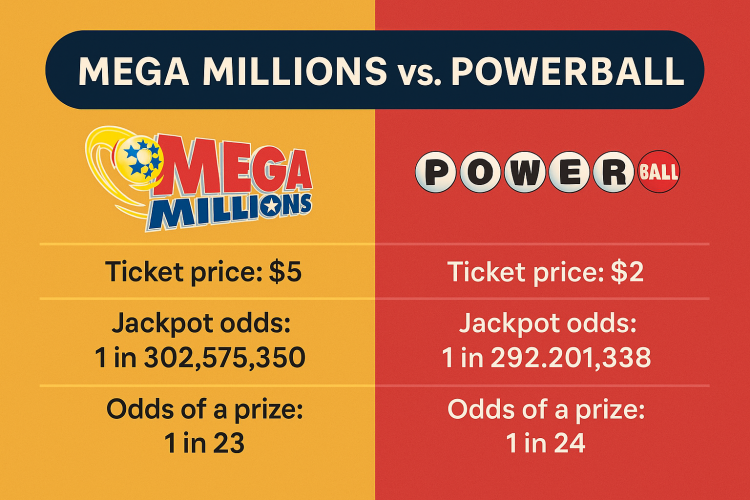
Now that Mega Millions has stepped into a flashier, more expensive format, it’s fair to ask: how does it compare to its longtime rival, Powerball?
Let’s start with the cost. Powerball still holds at $2 per ticket — or $3 if you add the Power Play. That means Powerball currently offers a much more affordable entry point for regular players. It’s easier to build a habit around, easier to buy multiples, and for many, that matters.
When it comes to jackpot odds, Mega Millions is still slightly tougher: 1 in 302.6 million vs. Powerball’s 1 in 292.2 million. It’s a small difference in practical terms — both are astronomical — but it technically gives Powerball the edge.
As for overall odds, Powerball’s are now slightly less favorable than Mega Millions: 1 in 24.87 vs. Mega’s new 1 in 23. However, Powerball still offers the break-even prize — you can win your $4 back — which Mega Millions has eliminated entirely. That makes Powerball feel a bit more generous to low-tier winners.
Then there’s the prize structure. Mega Millions now offers richer second-tier prizes, sometimes reaching $5 million with Megaplier. But Powerball’s top second-tier prize is more consistent: $1 million, doubled to $2 million with Power Play. It’s not as flashy, but it’s steady.
So what’s better? If you want slightly better jackpot odds and a lower-cost ticket, Powerball may still be your game. If you’re chasing bigger prizes and don’t mind the steeper buy-in, Mega Millions has upped its appeal — but also raised the stakes.
What This Means for Regular Players
For some diehards, this makeover feels like a betrayal of what made Mega Millions charming in the first place — a cheap thrill with the potential for life-altering results. For others, it’s a welcome evolution that brings the game into the modern era.
What’s clear is that strategy needs to change. You’re now paying more for each ticket, but you’re also seeing richer non-jackpot prizes. That might mean playing less frequently but with greater impact. Or sticking with syndicates or office pools to stretch the value.
It also means reading the fine print, checking results more carefully, and making smart decisions if you do win. Because the ticket may be $5, but the consequences of winning — or thinking you did — can be far more complex than they used to be.
Is It Still Worth Playing?
That depends entirely on why you play. If you’re chasing a jackpot with retirement in your rearview mirror, it’s still as statistically unlikely as ever. But if you’re someone who enjoys the ritual — the fantasy of “what if?”—the new format arguably offers more excitement per play and a better chance of winning something meaningful.
For others, the increase in ticket price may be a dealbreaker. And that’s fine. But if you’re still in the game, know that you’re not just buying a number—you’re stepping into a faster, flashier version of the Mega Millions we’ve known for decades.

It’s all about Greed. The numbers already show at least 25% increase in revenue to the States. Between the algorithm & AI, these changes were NOT introduced to benefit the players.